PROTECTION: Provably Robust Intrusion Detection System for IoT Through Recursive Delegation
SAFECOMP 2025 Workshops (DECSoS 2025), Lecture Notes in Computer Science, vol. 15955, Springer, 2025
In brief
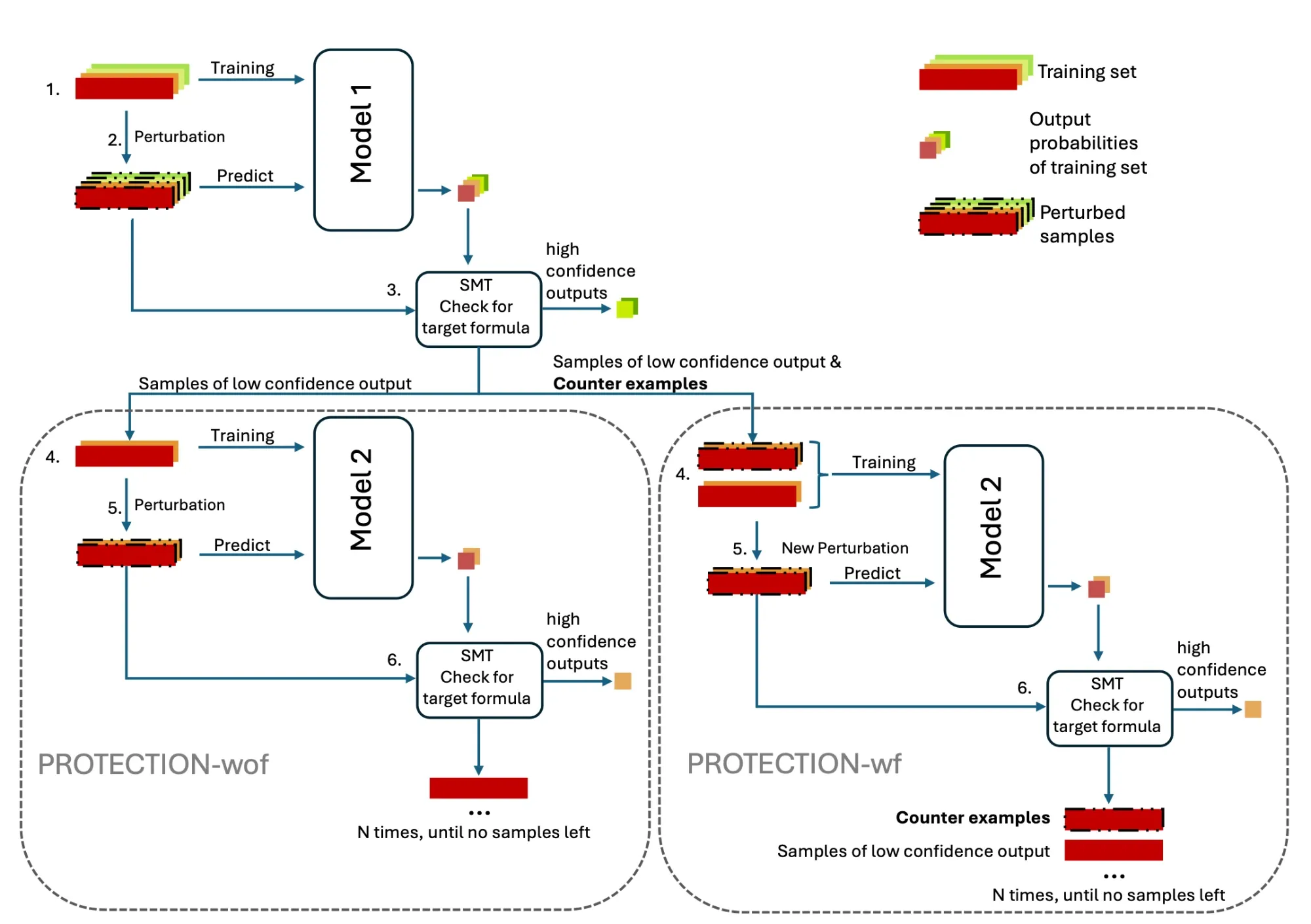
Machine-learning intrusion detection systems protect IoT networks, but they can be fooled by adversarial inputs and give no formal guarantee of robustness. PROTECTION combines ensemble machine learning with formal verification using Satisfiability Modulo Theories (SMT), checking that the classifier’s output probabilities stay stable when its inputs are slightly altered.
Overview
The security of Internet of Things (IoT) ecosystems is crucial for maintaining user trust and adoption. Intrusion detection and prevention systems based on machine learning are widely used to protect IoT networks, but they are vulnerable to adversarial attacks and their robustness cannot be formally verified.
PROTECTION addresses this by combining formal methods with ensemble machine learning. It uses Satisfiability Modulo Theories (SMT) to verify formally that a classifier’s output probabilities remain stable when its inputs are slightly perturbed.
The paper was presented at DECSoS 2025, the 20th International Workshop on Dependable Smart Embedded Cyber-Physical Systems and Systems-of-Systems, held with SAFECOMP 2025 in Stockholm.
Citation
Riad Ibadulla, Hafizul Asad. “PROTECTION: Provably Robust Intrusion Detection System for IoT Through Recursive Delegation.” SAFECOMP 2025 Workshops (DECSoS 2025), Lecture Notes in Computer Science, vol. 15955, Springer, 2025. doi:10.1007/978-3-032-02018-5_11